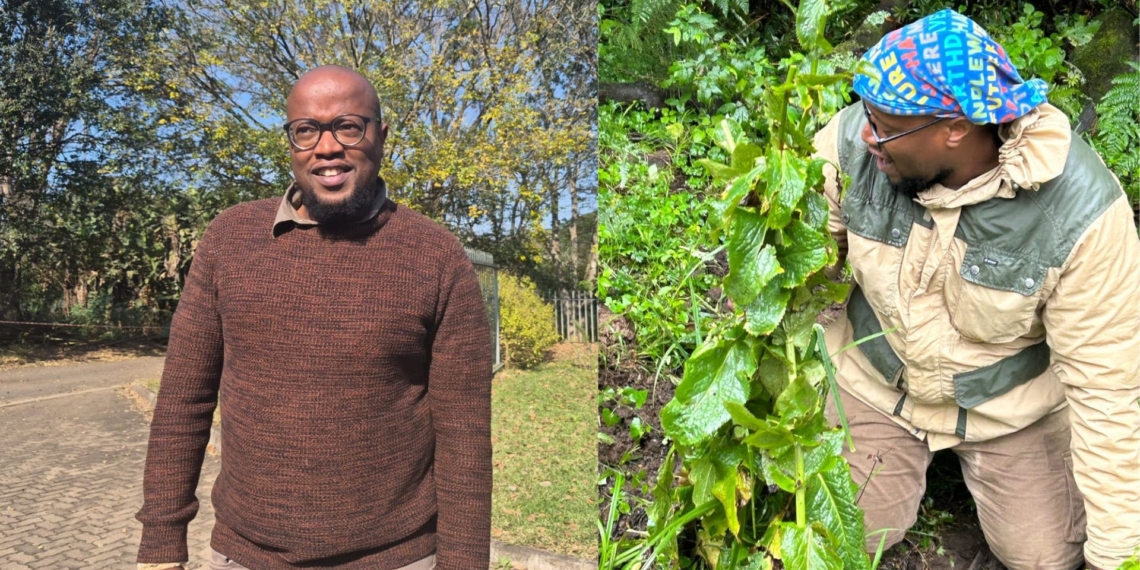
Lungisani Zondi grew up in Impendle, west of Pietermaritzburg near the Lesotho border. Impendle’s natural environment, including the Southern Drakensberg, uMkhomazi River, and Lotheni Nature Reserve, defined his upbringing.
This lifelong exposure to pristine landscapes and indigenous plants such as umdoni (Syzygium cordatum) and umbulwa (Diospyros lycioides) established his connection to the land, ultimately driving him to study horticulture at Durban University of Technology (DUT).
Ancestral roots and modern plant science
In winter, it was a fun time for Zondi to collect nectar from aloe ferox. These were normal childhood experiences, but in Zondi, they built a curiosity about plants and their uses. “One plant that stayed with me is umhlonyane (artemisia afra).”
Zondi says traditionally, when a young girl reaches her first menstruation, the family may hold a coming-of-age ceremony known as umgqomo or ukuthomba. During this time, umhlonyane is sometimes used in cleansing and bathing rituals.
“As a child, I did not question these practices. It was simply part of life.”

He adds that only later, through his studies in horticulture and plant science, did he begin to understand the deeper link between culture, plants, and well-being.
“What I have learned over time is not to separate indigenous knowledge from science but to see how they speak to each other.”
Lungisani Zondi
Science now helps to understand plants’ medicinal properties, he notes, but it does not replace that lived experience. “For me, this is where real knowledge sits.”
Zondi graduated from DUT in 2013. He says, “At first, I did not fully understand what horticulture meant. It only became clear later. My passion for plants began in 2011 when I volunteered at the KwaZulu-Natal National Botanical Garden under Sanbi.”
Working with indigenous plants and learning from experienced staff who generously shared their knowledge, changed his life.
Related stories
- Hardship forged Sihle’s passion for animal health
- Sibongile’s plant passion: Healing crops and feeding Mzansi
- Crop scientist Anele Danisa bridges gap between lab and land
Rising through the ranks
After completing his diploma, Zondi spent a brief period working for a commercial landscaping company. However, he quickly realised that his passion lay deeply rooted in conservation and botanical research.
Driven by this clarity, he returned to the KwaZulu-Natal National Botanical Garden as a horticultural intern. This time, he says, he had to supervise some of the same people who had trained him.
He adds that some were older than him, which was a bit challenging. However, he explains that it taught him humility, respect, and leadership.
“True leadership means being a public servant: taking the blame when things go wrong and giving your team the credit when things go well. My team didn’t expect me to have all the answers.
“Later, I worked on a project in Pietermaritzburg restoring Alexandra Park, managing a team of about 80 EPWP workers. It was demanding work, but it helped shape me further.”

In 2016, Zondi was permanently appointed at the Walter Sisulu National Botanical Garden in Johannesburg, where he remains today. He tells Food For Mzansi that he was far from home in a new environment and had to adapt to different languages and cultures.
“It is also where I developed a strong interest in cycads, one of the most threatened plant groups in the world, and in medicinal plants that connect strongly with my upbringing.”
Over nine years, he grew from a candidate horticulturist to a senior horticulturist while completing his master’s degree on imphepho (Helichrysum odoratissimum) from Tshwane University of Technology (TUT).
How science validates traditional plant use
Zondi explains that the South African National Biodiversity Institute (Sanbi) prides itself on knowledge generation to help the government make informed biodiversity policies, so the organisation actively supports education.
Working on imphepho in a scientific context while also understanding its cultural importance brought everything together for Zondi.
He notes that it was not just a research topic. “It showed me that what we call traditional knowledge and what we call science often describe the same relationship between people and nature, just in different ways.”
Zondi explains that imphepho contains compounds such as beta-caryophyllene, which research suggests may interact with the nervous system and contribute to a calming effect.

He says science does not replace the cultural meaning of the practice; it only adds another layer of understanding.
Science also helps explain other traditional uses of imphepho, he adds. It contains compounds such as alpha-pinene, which produce a strong aroma that can interfere with how insects locate humans. This explains why it has traditionally been used as a natural insect repellent.
Beyond kasi boundaries
Zondi points out that the reality for many black youth from townships and rural areas is that their background heavily dictates their future.
Without early career guidance, choosing a tertiary or professional path is rarely about passion; it is about survival and securing a paycheck. Early on, Zondi himself didn’t have a fixed direction, just a vague interest in agriculture.
But his journey proves that where you come from does not limit where you can go. Instead of a disadvantage, he views his rural roots as a foundation. “If my story can help young people value both their heritage and science, then I am truly grateful.”
READ NEXT: Drip irrigation: A game-changer for Zambian horticulture