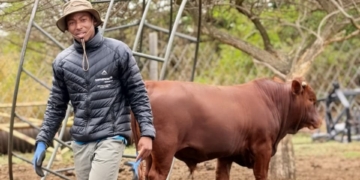
Women are playing an increasingly important role in South Africa’s agricultural sector, but gaps in land ownership, access to resources, employment and opportunities continue to limit their participation and growth.
The department of agriculture noted women remain central to the country’s food system, contributing as farmers, cooperative leaders, processors, employers, trainers and rural community members. However, expanding this contribution requires better access to land, finance, training, markets, research and practical support.
For young women entering agriculture, access to productive assets can make a significant difference.
Pathways to land ownership for SA women in farming
Nosipho Vuthela, a young farmer from the Eastern Cape and leader of Gedlumhlanga Youth Co-op, said the cooperative had a difficult start.
“We started with just a 1963 tractor bought by my grandfather, so it was very strenuous in 2020. Today, through the support of Eastern Cape Development Corporation and the office of the premier, we now have two new tractors,” she said.
Related stories
- Women trailblazers honoured for driving change in SA farming
- Mothers of the land: Celebrate women who feed and teach Mzansi
- Women farmers call for inclusive growth and development
- Women farmers step forward to shape SA’s food future
The cooperative also partners with Potatoes SA for seed support, helping it increase yields and reach larger markets. Infrastructure support from the department of agriculture and rural development further assisted the group with sorting and storage facilities.
Vuthela believes that while support programmes are important, women farmers also need greater visibility and opportunities to participate in agricultural discussions.
“All the support is there, but at the end of the day it comes down to hard work and team commitment. That’s what’s moving us forward. What needs to change is that our government must be serious about opening opportunities for us,” she said.
“They must include women farmers in agricultural seminars and panels so we can share our stories and production programmes.”
Vuthela also called for greater efforts to introduce young people to agriculture as a career, particularly through schools and high schools. Her call for greater youth participation comes against the backdrop of a sector that still needs to broaden its ownership base.
Breaking ownership barriers through policy and support
Agricultural economist Wandile Sihlobo explained that although gender diversity in commercial farming still has considerable room for improvement, the picture is not entirely negative. Of the 40 122 farm units registered for VAT, approximately 20% are owned and operated by women, according to the figures cited in the source.
“The ownership and operation of the commercial farming unit is much better than some may have anticipated. For example, of the 40 122 farm units registered for VAT, for which the threshold is a turnover of R1 million a year, about 20% are owned and operated by women.”
The bigger question, he said, was how this participation can be expanded, particularly through land reform.
He points to South Africa’s Beneficiary Selection and Land Allocation Policy, which states that 50% of redistributed land must be transferred to women.
“If this can be implemented effectively, we would make a significant improvement in gender diversity in South Africa’s agriculture,” he said.
Creating pathways from employment to ownership
Commercial fruit farmer Debbie Theunissen argues that new approaches to land access could help create pathways into ownership.
She suggests that high-performing agricultural employees could be rewarded with access to a portion of land and water, while the government and industry could help map the financial requirements needed to establish viable enterprises.
Theunissen also proposes tertiary exit programmes that identify high-performing female agricultural students and place them on structured pathways involving leased land and water, with the eventual goal of ownership.
“Task them after a year of post-study pracs to come up with ideas for starting their own farming enterprise and sponsor the promising candidates with land leases and other departmental initiatives,” she said.
She believes opportunities should extend beyond primary production into the broader agricultural value chain.
“And what about the supply chain packhouses: cold storage, distribution shareholding opportunities abound and should be facilitated for the aspirant candidates.”
Infrastructure and business support can unlock growth
For existing women farmers, infrastructure and business support can also unlock growth.
Eastern Cape crop producer Xolelwa Koncoshe says fencing, a borehole, solar-powered water infrastructure and a business plan supported through the Small Enterprise Development and Finance Agency (Sedfa) helped her secure additional production infrastructure.
Koncoshe said infrastructure support, including fencing, a borehole, solar-powered water tanks, together with a business plan funded by Sedfa, had the biggest impact on her farming operation. The business plan also helped her secure a growing tunnel, biogas digester and shade net.
“I would say investing in women because they are very resourceful. It doesn’t matter how small that investment may seem, but it is definitely worth the effort because they will multiply it,” she said.
READ NEXT: Trailblazers call for greater access, opportunity for women in agri