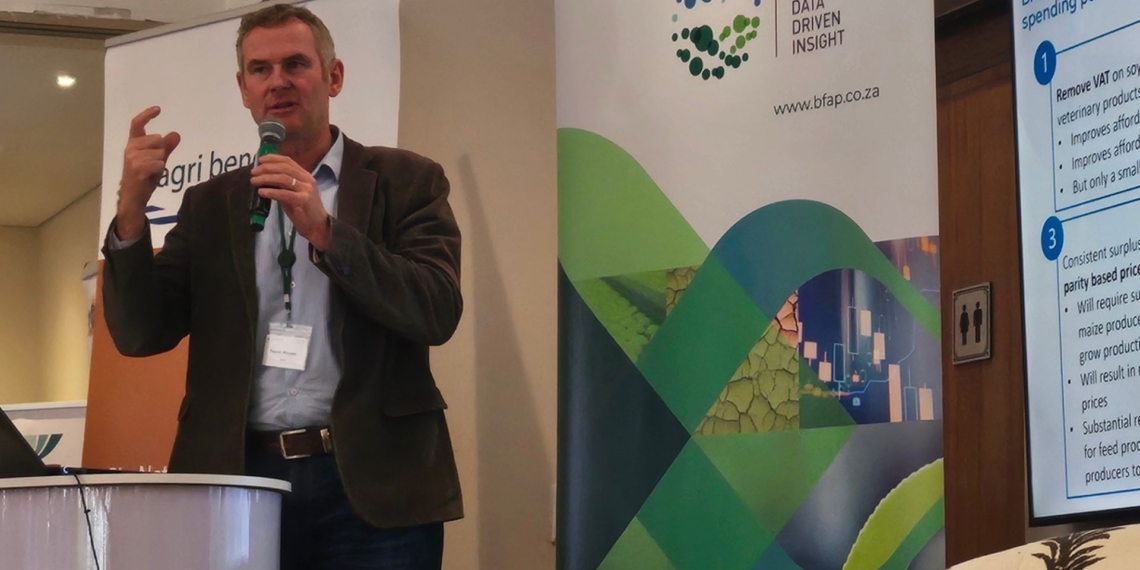
Collaboration, disease management, traceability, research investment and export market development emerged as key themes at the recent BFAP Global Livestock Forum in Pretoria. Local and international experts explored the future of livestock production in an increasingly complex global environment.
Opening the forum, Jan Hendrick Venter, director of plant health at the department of agriculture, emphasised the interconnected nature of modern food systems and the need for greater cooperation across agricultural sectors.
“We gather here today at a time when livestock production stands at the intersection of immense opportunity and profound responsibility.
“Few sectors are as central to food security, economic development, rural development and social stability as livestock production. The discussions we have are therefore not merely about animal production systems or markets; they are about people, livelihoods and information,” he said.
Value of healthy feed, progress on FMD
Venter reminded delegates that livestock production begins with healthy plant systems. Venter emphasised that sustainable livestock production depends on healthy plant systems, as plant health underpins feed production, animal health and ultimately food security.
He warned that climate change, geopolitical instability and biosecurity threats continue to place significant pressure on agricultural value chains.
Related stories
- FMD: South Africa’s beef industry pays price for poor traceability
- Cape Town port hits rock bottom: Ranked last in global index
- PPECB explains ‘passports’ to export success for SA farmers
- Extension services must bridge the gap from harvest to market
On foot-and-mouth disease (FMD), he said South Africa was making steady progress through its vaccination campaign, with nearly 5.5 million cattle vaccinated by 11 June, representing about 43% of the national herd.
“We have lost markets because of foot-and-mouth disease. We cannot currently access China, which is a huge market we want to expand into. Hopefully, once we establish FMD-free zones, we can open that door,” he said.
Venter stressed that future success would depend on stronger partnerships and data-sharing.
“No single institution possesses all the expertise, resources or information required to address the complexity of modern livestock production systems. Success depends on networks of expertise and, most importantly, trust,” he said.
Lessons from Brazil
Providing an international perspective, Giovanni Penazzi, production analyst at CEPEA in Brazil, outlined how traceability has evolved in one of the world’s largest cattle industries.
With more than 200 million head of cattle, Brazil historically relied on animal movement records to support disease control and market access.
“For a long time, analysing herd movements was sufficient to ensure compliance with vaccination requirements,” Penazzi explained.
Following Brazil’s achievement of FMD-free status without vaccination in 2025, the country has entered a new phase.
“Now it is no longer enough to analyse only mob transportation. We need to understand what happens to each individual animal within the herd,” he said.
Penazzi said government, private sector stakeholders and research institutions are working together to strengthen traceability systems and maintain export competitiveness, while importing countries increasingly require higher standards of quality and traceability.
Meanwhile, Dr Marlene Louw, CEO of the South African Pork Producers Organisation (Sappo), called for a new approach to agricultural research and development (R&D), arguing that public and private sectors must work more closely together.
“For a long time, we have taken research for granted. Covid-19 made all of us realise that significant investment is required, and public investment alone is not going to be enough.”
Louw argued that South Africa needs to strengthen public-private partnerships to ensure sustainable funding for agricultural research and development. She emphasised that developing meaningful agricultural solutions requires long-term investment, often spanning 10 to 15 years, and that strong public institutions remain essential to supporting innovation.
MENA markets: growth opportunities for meat exports
Agribenchmark economist Isam Almadani highlighted opportunities in the Middle East and North Africa (MENA) region.
“If we want to frame the MENA region in one sentence, we can say it is one of the most structurally import-dependent meat markets in the world,” he said.
While demand for imported meat is expected to remain strong due to water scarcity, limited grazing resources and population growth, Almadani noted that the region is highly diverse.
“The MENA market is not one homogeneous market. It is highly segmented, both economically and structurally.”
He believes South Africa should avoid competing solely as a commodity supplier. “South Africa has a great opportunity to establish itself as a reliable supplier of high-quality, halal-certified meat.”
Khani Baloyi, analyst at BFAP, highlighted the need to better understand South Africa’s communal and small-scale livestock sector.
“We do not currently have a proper understanding of the communal small-scale production sector,” she noted. However, Baloyi sees opportunities emerging as younger and more commercially minded producers enter agriculture.
“Young people are coming into agriculture as a business and an investment opportunity rather than purely as a lifestyle choice,” she said.
READ NEXT: Smart farming: 8 practical tips to adopt agritech today