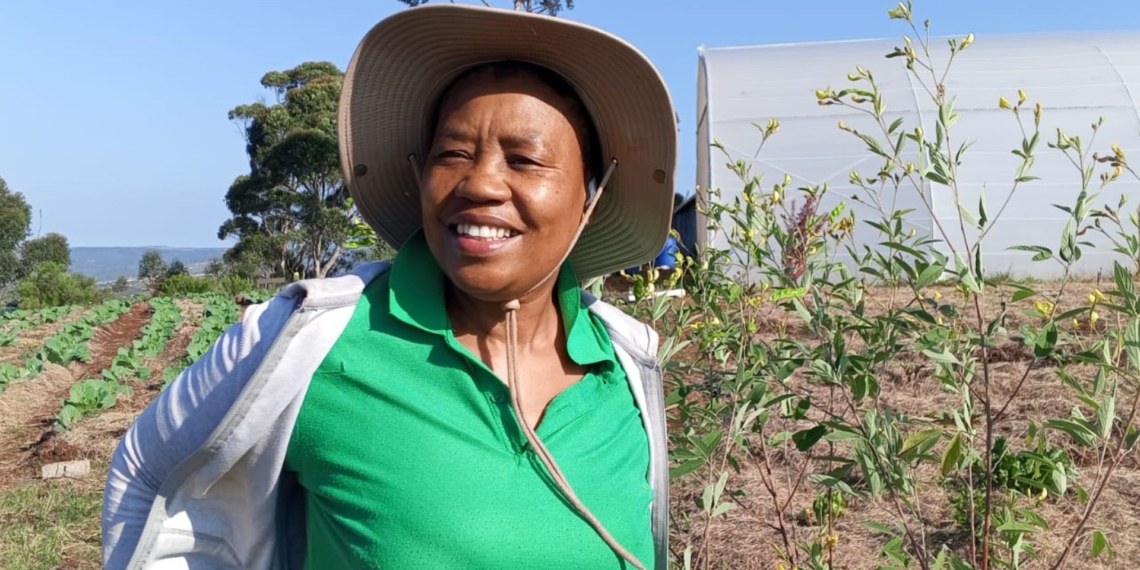
Xolelwa Koncoshe is leading a food revolution in Ncera Village, Eastern Cape. Through agroecology, a community seed library, and a five-hectare food hub, she’s helping local farmers build climate-resilient, self-sustaining businesses.
Koncoshe is a founding member and director of Senjenje Multipurpose Cooperative, a women- and youth-owned enterprise managing production at the food hub, and founding chairperson of the Ncera Information Resource Centre.
She also co-founded the Ncera Small Scale Farmers Foundation, where members work to improve yields and strengthen their businesses.
A legacy of feeding the community
Her agroecology journey began with her grandmother, Nompunzi Koncoshe, who produced much of the family’s food.
Born in Mdantsane township in KuGompo, Koncoshe spent her formative years in Mthlabathi Village, but her family later moved to Ncera Village in 2013.

Her grandparents produced vegetables, maize and wheat.
“I still remember the smell of fresh bread baked by my grandmother on her coal stove,” Koncoshe recalls. “Her garden was green throughout the year, and I never remember her buying seedlings.”
Her family also raised cattle, goats, chickens and pigs, so buying meat was rare. She remembers asking her mother how such a large pig could feed the family without refrigeration.
“She explained that when one household slaughtered an animal, they shared the meat with the entire extended family,” Koncoshe says.
“Food was never just for one household; it was something that brought the community together.”
Related stories
- Taleni Farmers Co-op grows hope in rural Eastern Cape
- Visionary farmer takes agritourism to KZN village
- Betty Nkoana’s gardens bring hope to struggling families
- Growing more than food: Ngxanga shapes future farmers
A taste of entrepreneurship
After matriculating in 1993, Koncoshe spent a year learning to knit and started a small knitting business, giving her an early taste of business.
In 1995, she enrolled at the University of Fort Hare for a bachelor of nursing degree, with a full Usaid scholarship. After nearly two decades as a nurse, she took a career break in June 2018 and returned home to Ncera Village, where she began exploring farming.
Although she returned to work in that year, she eventually made Ncera her permanent home two years later during the Covid-19 lockdown.
Koncoshe first encountered agroecological farmers while attending a programme held at a rural school. A visit to a farmer in Quzini Village in Qonce changed her view of agriculture. “It was around 34°C, but despite the heat, the crops in the farmer’s garden were green and healthy.”

She explains how she learned that healthy soils helped the ground retain moisture and protect crops during harsh weather.
Inspired, she returned home to experiment with raised beds. One neighbour, she says, joked she was digging graves. Heavy rains later washed away her first attempt.
Learning through agroecology, she persisted and joined a WhatsApp group where farmers offered guidance. During the Covid-19 lockdown, she committed fully to agroecology and her garden flourished.
She introduced rainwater harvesting, which the same neighbour eventually adopted.
Building the food hub
Koncoshe volunteered with the Isithembiso Multipurpose Organisation, assisting with administration and compliance. In 2021, the organisation secured funding for the development of a five-hectare site.
An abandoned farmhouse became the Ncera Information Resource Centre with a community seed library. The site has a solar borehole, fencing, growing tunnel and biogas digester.
“The biogas digester produces clean cooking gas and nutrient-rich liquid fertiliser, while a worm farm and herbs grown for green manure form part of the agroecological system.”
Today, the food hub grows tomatoes, spinach, carrots, okra, cauliflower, broccoli, peppers, cucumbers, turnips, lettuce, beans, maize, beetroot, butternut, onions, pumpkins and watermelons, plus herbs.

The site has a food forest with more than 200 fruit and indigenous trees, including banana, peach, lemon and custard apple, supplying Boxer in Duncan Village.
“Diversification is deliberate,” she says, explaining that they grow different crops for food and local markets, while others serve as trap crops to manage pests naturally.
Growing beyond production
One of her proudest achievements came through the Recognition of Prior Learning programme offered by Tardi College with AgriSETA. She encouraged farmers in her network to apply, resulting in 13 producers securing formal agricultural qualifications.
In 2025, she participated in a farmer exchange programme to Zimbabwe organised by the Agroecology Action Collective. She spent a week in Shashe Village at the centre of excellence.
“What can I say, agroecology farmers in Zim are well organised; they save seeds, they grow food, process it,” she notes. The homesteads practise agroecology through seed banks, food banks, fish and livestock, producing much of what they need themselves.

Looking ahead, Koncoshe wants the food hub to process more produce and reduce post-harvest waste.
“The success would be when the food hub can support homestead gardeners with agro-processing facilities to reduce post-harvest waste at a household level,” she says.
For Koncoshe, success means a self-sustaining farm whose fertilisation programme comes from within, producing compost and liquid fertiliser and building healthy soil for production.
READ NEXT: How seed banks and libraries protect Mzansi’s future