As part of a SANSOR campaign, this article highlights how the South African seed industry is responding to an emerging threat called Goss’s wilt.
For generations, South African maize farmers have battled pests, droughts, and fluctuating markets. However now, a new and unfamiliar enemy has arrived – Goss’s Wilt.
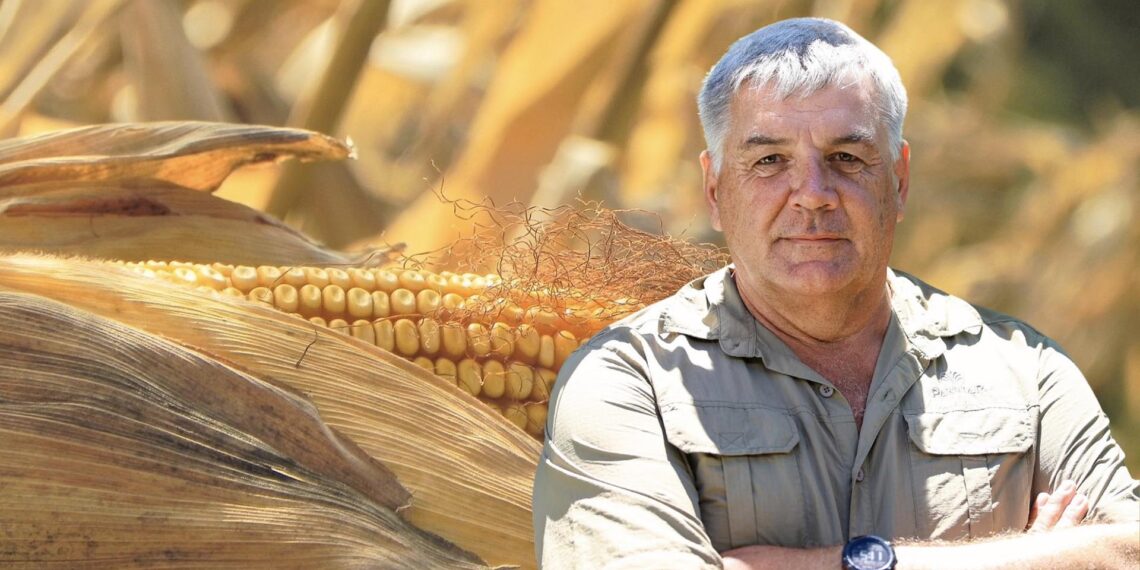
Dr Rikus Kloppers, a private consultant at Robigalia Cropcare, explains, “I think a lot of us hope we never heard about the name, but it is a new bacterial disease that made its way into South Africa.”
While Goss’s Wilt might be new to South Africa, it is far from an unknown foe in the global maize industry.
Caused by the bacterium Clavibacter michiganensis subspecies nebraskensis (or simply Clavibacter nebraskensis), this disease was first identified in Nebraska, USA, over 30 years ago.
Unlike the fungal diseases that maize farmers are accustomed to managing, Goss’s Wilt is bacterial and has no known chemical control methods – making it much harder to control and eradicate.
How it got here
Diseases can spread in many ways, through equipment, people, seed etc. in this case moving across the Atlantic, we know it is seedborne and seed transmitted, and although at a very low rate the most likely scenario.
“So far, Goss’s Wilt has only been known to occur in the US over the Corn Belt and up into Western Canada, and nowhere else in the world,” says Kloppers. However, early in 2024, reports emerged suggesting the disease had crossed into South Africa. “The suspicion is clearly that it might have been through seed,” he explains.
But while the initial introduction may have come from infected seeds, the real danger lies in how it spreads once it establishes itself. The seed-borne and the seed transmission aspects of this disease is extremely low and most disease spread occurs when you have a field that is infected with the disease and you send a combine through.
The dust particles can spread from field to field and eventually cover big areas.
This airborne dispersal is precisely how Goss’s Wilt became widespread in the US, where wind-driven dust created vast inoculum clouds, infecting new fields rapidly. In South Africa, the same risk looms large, particularly in regions where susceptible hybrids are planted in close proximity.
Related stories
What farmers should do
One of the biggest challenges in managing Goss’s Wilt is the fear of reporting it. “A lot of farmers are very hesitant to report the disease,” Kloppers acknowledges.
“There have been past incidences where a new disease or pest arrives in the country and quarantine measures take place.”
However, in this case, the National Plant Protection Organization of the Department of Agriculture have assured farmers that widespread quarantine measures will not be implemented. “The disease has been fairly widespread in South Africa, so you can’t really quarantine the whole maize industry in South Africa,” he explains.
Instead, Kloppers urges farmers to take a proactive stance: “If you find the disease on your farm, report it. Report it to the Department of Agriculture, report it to your local seed representative and agronomist who can escalate that message.”
Understanding the extent of the disease is critical. “We always say, once you know your enemy, if you can measure something, then you can manage it,” says Kloppers. “And in this case, we need to establish where it now occurs
How farmers can protect their crops
While fungicides and other conventional crop treatments are ineffective against bacterial diseases like Goss’s Wilt, there is hope. “The primary way of managing the disease, and the success story in the U.S., is through resistant breeding,” Kloppers explains.
Although South Africa had no prior need to develop resistant hybrids, the global seed industry operates on an interconnected scale.
“Because of exchange of germplasm across the globe, we’ve already seen that some of that resistant germplasm that was developed over 30 years in the U.S. has made its way to South Africa.
“From now on, there’s huge focus from different seed companies and their breeders to incorporate that resistance or tolerance into the locally adapted germplasm.”
Seed companies are now prioritising the identification and distribution of hybrids with low susceptibility to Goss’s Wilt. “If you are in a risk area, this hybrid is a low-risk hybrid in terms of Goss’s Wilt,” Kloppers advises.
Preventing future outbreaks
The spread of Goss’s Wilt has raised concerns about the ability of the seed industry to detect and contain new threats. Fortunately, South Africa’s seed industry operates under stringent regulations. “Seed production is monitored almost on a daily basis, and any foreign or strange symptom that’s seen in those productions is either sampled or reported,” Kloppers assures.
While the seed industry is taking proactive steps, the reality remains: preventing a disease from entering the country is much easier than managing it once it’s here. Farmers must now rely on collective vigilance, open communication, and the rapid adoption of resistant hybrids to limit the damage.
South African farmers have always demonstrated resilience in the face of adversity. But Goss’s Wilt is not a battle that can be fought alone. Early detection, transparent reporting, and the adoption of resistant hybrids will determine the future of maize farming in South Africa. Together with getting rid of infected debris and rotating with non-host crops like soybeans this disease can be managed down to acceptable levels.
As Kloppers puts it: “For us, it’s now really critical that we know where the disease is.”
The choice is clear: farmers must act now to protect their future—or risk letting Goss’s Wilt rewrite the fate of South Africa’s maize industry.
READ NEXT: Groundnut farming: Key tips for success
Sign up for Mzansi Today: Your daily take on the news and happenings from the agriculture value chain.