Monday, October 12, 2026
SUBSCRIBE
22 GLOBAL MEDIA AWARDS
Food For Mzansi
  • News
  • Changemakers
  • Lifestyle
  • Farmer’s Inside Track
  • Food for Thought
No Result
View All Result
  • News
  • Changemakers
  • Lifestyle
  • Farmer’s Inside Track
  • Food for Thought
No Result
View All Result
Food For Mzansi
No Result
View All Result
in News

SA agri-exporters urged to seek new markets

With South Africa’s agricultural production on the rise, finding new markets isn’t just a good idea – it’s a commercial imperative. At a recent G20 side event, experts highlighted the need to build long-term relationships in non-traditional markets

by Vateka Halile
16th September 2025
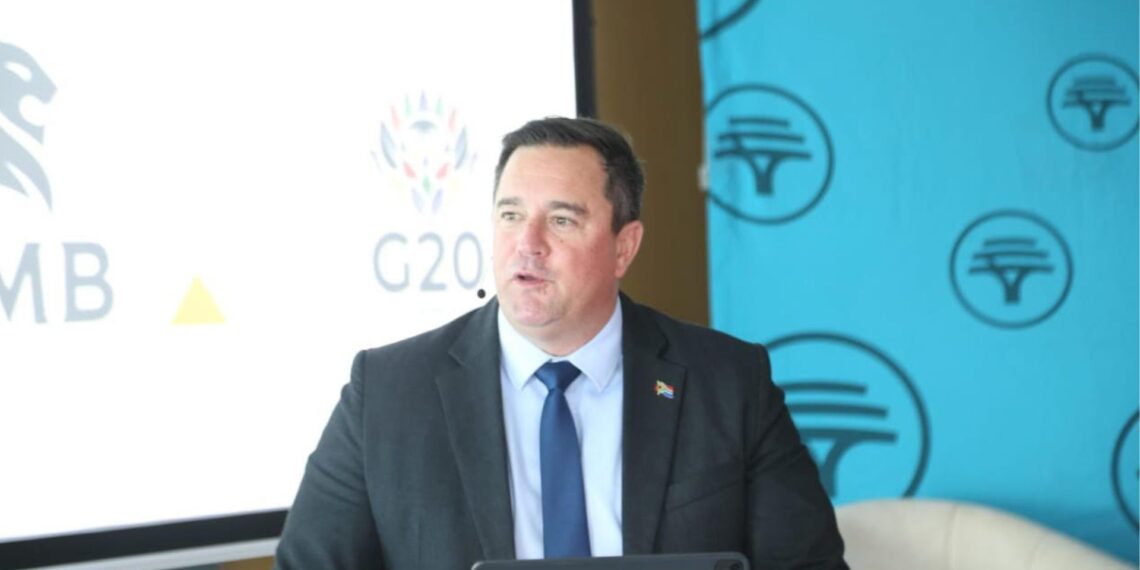
Agriculture minister John Steenhuisen has warned of a deepening crisis at the Matlosana Fresh Produce Market after the local municipality failed to obey a 2021 court order. Photo: Supplied/Food For Mzansi

Agriculture minister John Steenhuisen has warned of a deepening crisis at the Matlosana Fresh Produce Market after the local municipality failed to obey a 2021 court order. Photo: Supplied/Food For Mzansi

Share on FacebookShare on TwitterShare on WhatsApp

With ongoing geopolitical changes, South Africa’s agricultural exporters are being encouraged to move into non-traditional markets. This was the view at an exclusive side event of the G20 Agriculture Ministerial Meeting, hosted by First National Bank and other stakeholders.

The event brought influential role players together to discuss how G20 frameworks can create new opportunities for South Africa’s agricultural sector.

Representing farming organisations were Theo Boshoff, CEO of Agbiz; Christo Conradie, market access and policy manager at South Africa Wine; Gerrit van der Merwe, chairman of the Citrus Growers’ Association (CGA); Paul Makube, senior agricultural economist at FNB; and minister of agriculture, John Steenhuisen.

Makube said South Africa’s presidency of the G20 is a crucial opportunity to address challenges faced by agricultural exporters in a changing global geopolitical landscape.

“Changing environments are requiring the agri sector to look to diversify markets. Agri market participants can help future-proof their export strategies by deepening relationships in non-traditional markets and by taking steps to actively build their trade resilience for the future,” he said.

Diverse markets vital for sustainability

He added that local growers need to be responsive to international trends. “Global trade is fragmenting, protectionism is rising, and markets are turning inward, and agricultural trade is no exception. South Africa has to respond accordingly.”

South African citrus production provides a clear example. Production has increased, creating a need for more markets. Estimates for the current season have been revised upwards, with total exports forecast at nearly 190 million cartons, up from 171 million earlier in the year. With more orchards reaching maturity, this trend is set to continue.


Related stories
  • High-value exports navigate trade shocks
  • Water security becomes a business imperative for farmers
  • Unlocking modern markets for traditional healers
  • Land Bank back on track, boosting support for farmers

“If we don’t find new markets, we’ll have more fruit than we can sell. That’s why market diversification isn’t just a good idea; it’s a commercial imperative.

“We’re already seeing zero-tariff access for key commodities like citrus, nuts and meat into China, and that can be a game-changer for many farmers. While India still poses high barriers, it’s a massive and growing population coupled with a rising middle class, meaning it’s a market worth cultivating. These are the places where the next decade of growth for SA agri will almost certainly come from,” he explained.

Makube noted that market development in the agricultural sector is about playing the long game. Sustainable success depends on relationships, not transactions, so it’s important to invest in long-term connections now, even if it means accepting tighter margins in the short term.

Building a competitive sector

Meanwhile, Steenhuisen said that the clear lesson is that South Africa’s agricultural growth and resilience will come from expanding markets and opportunities rather than just simply erecting trade barriers.

“We’ve already seen large uptake on the ground from our Agro-Energy Fund, which is looking to help through a blended finance scheme, assist farmers to be able to move towards cheaper, more effective, efficient and more environmentally friendly energy sources.”

Boshoff added that market access on its own is not enough to keep South Africa’s agriculture competitive.

“Market access, I would say, is probably the foot in the door, but it’s certainly not enough to be competitive. That’s why I prefer the concept of market competitiveness. And that applies both domestically as well as internationally,” he said.

Boshoff pointed out that competitiveness is shaped by the cost of doing business, using soybeans as an example. “We are right next door to the harbour, and while soya has filled the gap between import and replacement, we are now actually self-sufficient in exports.

“However, if you look at the growing regions in the north, especially the maize belt, a lot of animal feed manufacturing is down here. It is still cheaper to import soybeans from Argentina than it is to truck them down from inland. If rail was working, it could be a very different situation,” he said.

READ NEXT: Electricity hikes add to SA farmers’ financial pain

Sign-up for the latest agricultural news delivered straight to your inbox every day with Mzansi Today!

Vateka Halile

Vateka Halile grew up in rural areas of Cofimvaba in the Eastern Cape. She was raised in a traditional family setting and found writing to be a source of comfort and escape. Vateka participated in an online citizen journalism course through Food For Mzansi, and her passion for health and medicine-related stories was born. Her dedication to community work and love for social justice and solidarity spaces is evident in her quality time with the community when she isn't working.

Tags: Agricultural exportsFNB AgribusinessInform meJohn SteenhuisenPaul MakubeTheo Boshoff
Govt gives Land Bank money for blended finance
News

Hope restored as Land Bank secures R500m to end funding freeze

by Olwam Mnyande
9th October 2026

The department of rural development and Land Reform has signed an agreement with Land Bank, committing R500m in grant funding...

Read moreDetails
Young Lady Grey farmer diversifies from broilers to shisanyama

Young Lady Grey farmer diversifies from broilers to shisanyama

9th October 2026
Four major risks SA farmers can’t afford to ignore

Four major risks SA farmers can’t afford to ignore

9th October 2026
Scrapping the sugar tax is key for survival of the sugarcane industry.

Scrap sugar tax to save farmers and jobs, SA Canegrowers plead

9th October 2026

Phelisa Ndayi brings soil science and smart tech to Mzansi farmers

8th October 2026

Young Lady Grey farmer diversifies from broilers to shisanyama

Protect your spinach crops from extreme heat this summer

NW government boosts Taung lucerne farmers with new packhouse

Energy shock, weather risks drive operational costs for SA farmers

Mastering foreign exchange: Smart strategies for SA agri exporters

Join Food For Mzansi's WhatsApp channel for the latest updates!

JOIN NOW!
Next Post
How to bridge the ‘missing middle’ in agri-finance

How to bridge the ‘missing middle’ in agri-finance

THE NEW FACE OF SOUTH AFRICAN AGRICULTURE

With 21 global awards in the first six years of its existence, Food For Mzansi is much more than an agriculture publication. It is a movement, unashamedly saluting the unsung heroes of South African agriculture. We believe in the power of agriculture to promote nation building and social cohesion by telling stories that are often overlooked by broader society.

The numbers every farmer should know

Palesa proves small-scale farming can feed communities, retailers

Protect your spinach crops from extreme heat this summer

This week’s agri events: 12 – 16 October

From five fish to a commercial farm: Meet the AWSA !Xhariep winners

Booberries campaign brings breast health to Checkers shelves

  • Awards & Global Impact
  • Our Story
  • Contact Us
  • Cookie Policy
  • Privacy Policy
  • Copyright

Contact us
Office: +27 21 879 1824
News: info@foodformzansi.co.za
Advertising: sales@foodformzansi.co.za

Contact us
Office: +27 21 879 1824
News: info@foodformzansi.co.za
Advertising: sales@foodformzansi.co.za

  • Awards & Global Impact
  • Our Story
  • Contact Us
  • Cookie Policy
  • Privacy Policy
  • Copyright

Chat Options

I'm Lerato, your AI assistant!
No Result
View All Result
  • News
  • Changemakers
  • Lifestyle
  • Farmer’s Inside Track
  • Food for Thought

Copyright © 2024 Food for Mzansi