
Wednesday, November 25, 2026
SUBSCRIBE
22 GLOBAL MEDIA AWARDS
Food For Mzansi
  • News
  • Changemakers
  • Lifestyle
  • Farmer’s Inside Track
  • Food for Thought
No Result
View All Result
  • News
  • Changemakers
  • Lifestyle
  • Farmer’s Inside Track
  • Food for Thought
No Result
View All Result
Food For Mzansi
No Result
View All Result
in Mzansi Flavour, Recipes

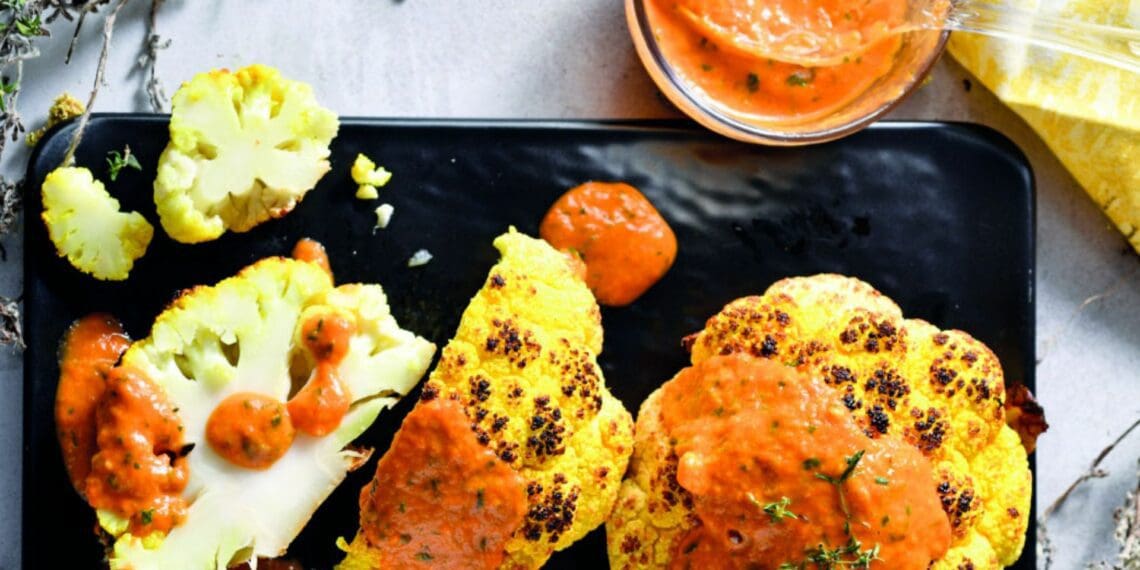
Make Mokgadi’s impepho-smoked cauliflower

When health is wealth, should it really cost you an arm and a leg? Not in chef Mokgadi Itsweng’s books. Try out the former food editor’s recipe for a plant-based impepho-smoked cauliflower with a red pepper sauce

by Noluthando Ngcakani
5th August 2022
Add FFM on Google
Chef Mokgadi Itsweng shares her recipe for impepho-smoked cauliflower with a red pepper sauce. Photo: Supplied/Food For Mzansi

Chef Mokgadi Itsweng shares her recipe for impepho-smoked cauliflower with a red pepper sauce. Photo: Supplied/Food For Mzansi

Share on FacebookShare on TwitterShare on WhatsApp

This whole roasted cauliflower with a red pepper sauce is a real treat with a truly Mzansi twist, impepho. Former food editor and cookbook author, Mokgadi Itsweng, modernises this traditional herb that is typically used by African healers, by creating a lipsmacking plant-based dish.

Still stuck on the idea that healthy is expensive? Not in Itsweng’s books. This award-winning chef with Durban roots believes that our belief of healthy food being expensive is what holds us back from enjoying plant-based cuisine.

In her new book, Veggielicious, chef and food activist Mokgadi Itsweng reworks South African recipes with plant-forward passion. Photo: Facebook/Mokgadi Itsweng
In her book, Veggielicious, chef and food activist Mokgadi Itsweng reworks South African recipes with plant-forward passion. Photo: Facebook/Mokgadi Itsweng

“I try to debunk that myth by showcasing recipes that are accessible and affordable in the South African context. I also include indigenous ingredients like sorghum, wild food like thepe [amaranth], to show the versatility of our South African ingredients and food.”

Her passion and expertise lie in reintroducing to our plates, with a modern infusion, indigenous foods that are good for the earth and for our health.

“In South Africa, people are moving away from rural areas to the cities and our indigenous food culture gets destroyed as people increasingly eat cheap, fast foods. Many people in our cities also now suffer from malnutrition and diabetes.”

Cooking from the garden of her dreams

You’ve likely seen Itsweng’s in iconic local publications like True Love, where she took the reign as food editor. She also holds more than 15 years of experience in the South African culinary industry as an award-wining chef, food activist, food entrepreneur and food writer.

In 2021 Itsweng unveiled her debut cookbook Veggielicious, an ode to the food garden of her dreams and a dedicated handbook for plant-forward eating. “Plant-forward eating refers to eating more plants on your plate,” she explains the inspiration behind her cookbook.  

Mokgadi Itsweng’s cookbook celebrates the garden and its seasonal bounty with easy, affordable and delicious recipes. Photo: Supplied/Food For Mzansi

She credits her food inspiration to her childhood food garden and local foodies like the late Mam’ Dorah Sitole, Zola Nene, Khanya Mzongwana and many more.

“The taste of fresh vegetables directly from the earth is unforgettable. This helped me to develop a deep love for vegetables.

“My paternal grandmother was a subsistence farmer who grew her own food and my maternal granny was a cook at a hotel in Durban. These two women played a big role in my food journey. I remember harvest time with my granny, where she would harvest the most beautiful pumpkins, ditloo and peanuts,” she says.

Mokgadi’s whole smoked cauliflower and red pepper sauce

Impepho or wild sage is an indigenous African herb that is widely used by traditional healers in spiritual prayer rituals. The herb is also used as an antifungal, antiseptic and anti-anxiety medicine. It adds so much flavour to any food it is smoked with.

“I use a kettle braai for smoking, but you can follow the quick smoking hack that I have included in the recipe,” she says.

ALSO READ: From selling sweets to owning a kasi restaurant

Get the Mzansi Flavour newsletter:  A weekly serving of craveable recipes and handy lifestyle tips.

Ingredients

  • 1 whole cauliflower head
  • Handful of dried impepho herb, for smoking the cauliflower
  • 1 garlic clove, crushed
  • ¼ cup (60 ml) olive oil
  • Salt and pepper to taste
  • Sauce
  • 2 red peppers, left whole
  • 2 tablespoons (30 ml) olive oil
  • 1 garlic clove, crushed
  • 1 tablespoon (15 ml) smoked paprika
  • ¼ cup (60 ml) lemon juice
  • 1 tablespoon (15 ml) brown sugar Salt and pepper to taste
  • Handful of fresh parsley or thyme, chopped

Instructions

1. Preheat the oven to 200 °C.

2. Bring a saucepan of water with 1 teaspoon (5 ml) salt to a boil, then add the cauliflower head. Cook for 10 minutes, then drain and set aside.

3. Smoke the cauliflower by placing a hot charcoal disk inside a small

foil container, then adding a handful of dried impepho herb. When the impepho starts smoking, place it inside a kettle braai with the cauliflower. Close the kettle braai lid and allow to smoke for at least 10-15 minutes. Remove from the kettle braai and set aside.

Quick hack: Use your oven as a smoker. Place the impepho on an oven tray, light it and when it starts to smoke place the tray on the bottom rack of the oven. Then place the cauliflower on the rack directly above the impepho. Close the oven and allow to smoke for 5-10 minutes.

4. Mix the garlic with the olive oil and brush over the whole cauliflower. Season with salt and pepper. Place on a baking tray and roast in the preheated oven for 30 minutes until crisp on the outside.

5. While the cauliflower is roasting, make the sauce by first roasting the peppers in the oven until the skins are blackened.

6. Remove the peppers from the oven and place in a bowl, cover with clingwrap and allow to cool for 10 minutes.

7. Once cooled, peel the skins off and blend the peppers, then set aside.

8. Heat the oil, then add the garlic and paprika, and cook for 2 minutes on medium heat. Add the blended peppers and cook for 5 minutes, stirring continuously to ensure that the sauce doesn’t stick and burn.

9. Add the lemon juice and brown sugar, cook for a further 2 minutes, then season with salt and pepper.

10. To serve, slice the cauliflower into steaks or leave whole, then place on a platter. Pour the sauce over the cauliflower and top with chopped herbs.

Add FFM on Google Follow FFM on Google News

Noluthando Ngcakani

With roots in the Northern Cape, this Kimberley Diamond has had a passion for telling human interest stories since she could speak her first words. A foodie by heart, she began her journalistic career as an intern at the SABC where she discovered her love for telling agricultural, community and nature related stories. Not a stranger to a challenge Ngcakani will go above and beyond to tell your truth.

Tags: Food inspirationHealthy recipesindigenous herbsplant-based food
This week’s agri events: 23 – 27 November
News

This week’s agri events: 23 – 27 November

by Tiisetso Manoko
23rd November 2026

Agricultural events taking place soon include the ARC Beef Performance Awards and RAP Agricultural Empowerment & Partnership Summit. Early-bird tickets...

Read moreDetails

When to plant fodder radish for better livestock feed in droughts

22nd November 2026
Neat rows of young crops cover a sloping green field beneath lush, forested hills and a dramatic, overcast sky.

Private partnerships unlock millions for land reform beneficiaries

21st November 2026
Rooibos industry targets global growth while protecting local roots

African markets offer fresh growth opportunities for SA rooibos

21st November 2026
A woman wearing a straw hat, glasses, and gardening gloves stands in a large field of leafy green crops under a blue sky.

Supplying Joburg Market: Phumla Qwabe grows her next chapter

20th November 2026

African markets offer fresh growth opportunities for SA rooibos

Boshof Solar Power backs three-year emerging farmer programme

Festive demand vs. El Niño: What’s driving SA’s livestock market?

Business-first mindset drives success for EC mohair farmers

Enza Zaden field days prove crop performance from farm to market

Join Food For Mzansi's WhatsApp channel for the latest updates!

JOIN NOW!
Next Post
Many South African businesses are forced to spend money they don’t necessarily have on diesel generators. An expert says, other companies should also enjoy the privilege to earn rebates for spending on diesel and suffering through the blackouts. Photo:Supplied/Food For Mzansi

Fuel rebates should expand to other businesses

THE NEW FACE OF SOUTH AFRICAN AGRICULTURE

With 21 global awards in the first six years of its existence, Food For Mzansi is much more than an agriculture publication. It is a movement, unashamedly saluting the unsung heroes of South African agriculture. We believe in the power of agriculture to promote nation building and social cohesion by telling stories that are often overlooked by broader society.

Veg prices crash ahead of festive season, squeezing SA farmers

Working with nature: How soil health builds resilient farms

Enza Zaden field days prove crop performance from farm to market

South Africa’s job crisis: Why the agricultural sector is bleeding

Boshof Solar Power backs three-year emerging farmer programme

Why seasonal rainfall averages don’t guarantee maize yields

  • Awards & Global Impact
  • Our Story
  • Contact Us
  • Cookie Policy
  • Privacy Policy
  • Copyright

Contact us
Office: +27 21 879 1824
News: info@foodformzansi.co.za
Advertising: sales@foodformzansi.co.za

Contact us
Office: +27 21 879 1824
News: info@foodformzansi.co.za
Advertising: sales@foodformzansi.co.za

  • Awards & Global Impact
  • Our Story
  • Contact Us
  • Cookie Policy
  • Privacy Policy
  • Copyright

Chat Options

About this assistant

This feature generates automated answers summarised from Food For Mzansi articles. By using it, you are interacting with an AI system (provided by Google), not a human. AI can make mistakes. Please refer to the source articles for verification and citation purposes.

Our staff do not check or moderate Lerato’s answers in advance, but may review some later. Our journalists continue to write and edit all the articles Lerato uses as sources.

To estimate unique and returning web users, we store a random browser ID in this browser. WhatsApp users are counted by phone number. The same person using both channels may be counted twice.

I'm Lerato, your AI assistant!
No Result
View All Result
  • News
  • Changemakers
  • Lifestyle
  • Farmer’s Inside Track
  • Food for Thought

Copyright © 2026 Food for Mzansi